TEPCO drowning in dealing with tons of radioactive water

As if Tokyo Electric Power Co., the embattled operator of the crippled Fukushima No. 1 nuclear power plant, didn’t have enough problems, another daunting task is what to do with an estimated 90,000 tons of radioactive water.

This vast amount remains from the pumping of water to cool reactors after the plant’s regular cooling systems were disabled in the March 11 Great East Japan Earthquake and seawater from the tsunami.

The problem is growing by the day, as the volume of contaminated water keeps increasing.

TEPCO needs to treat and recycle contaminated water escaping from the facilities to maintain the cooling of the reactors without increasing the volume of contaminated water.

It signed a deal with France’s Areva SA, a nuclear engineering company, to start treating the radioactive water in June. But Areva’s equipment is capable of treating only 1,200 tons a day, and it is not clear if it can handle a total of 90,000 tons.

In dealing with this volume of contaminated water, the plant’s No. 2 reactor presents the most serious challenge of its four stricken reactors.

Workers discovered on April 2 that highly radioactive water gushed into the sea through cracks close to a pit near an intake of the No. 2 reactor. Technicians spent a total of 93 hours before successfully plugging the leaks on April 6.

The contaminated water came from buildings housing the No. 2 reactor and turbine as well as a trench.

TEPCO is transferring the contaminated water to a disposal-and-treatment facility in the compound to prevent further overflow.

The total amount of contaminated water at the No. 2 reactor was estimated at 25,000 tons before the transfer work got under way, equivalent to about 400,000 terabecquerels of radioactivity.

via asahi.com(朝日新聞社):TEPCO drowning in dealing with tons of radioactive water – English.

It’s sad bad news about the fish

More than 40 species of marine fish currently found in the Mediterranean could disappear in the next few years. According to a study for the IUCN Red List of Threatened Species™ on the status of marine fish in the Mediterranean Sea, almost half of the species of sharks and rays (cartilaginous fish) and at least 12 species of bony fish are threatened with extinction due to overfishing, marine habitat degradation and pollution.

Commercial species like Bluefin Tuna (Thunnus thynnus), Dusky Grouper (Epinephelus marginatus), Sea Bass (Dicentrarchus labrax) or Hake (Merluccius merluccius) are considered threatened or Near Threatened with extinction at the regional level mainly due to overfishing.

“The Mediterranean and Eastern Atlantic population of the Atlantic Bluefin Tuna (Thunnus thynnus) is of particular concern. There has been an estimated 50% decline in this species’ reproduction potential over the past 40 years due to intensive overfishing,” says Kent Carpenter, IUCN Global Marine Species Assessment Coordinator. “The lack of compliance with current quotas combined with widespread underreporting of the catch may have undermined conservation efforts for this species in the Mediterranean.”

The use of fishing gear, such as fishing lines, gill or trawling nets, and the illegal use of driftnets means that hundreds of marine animals with no commercial value are captured, threatening populations of many species of sharks, rays and other fish, as well as other marine animals including dolphins, whales, turtles and birds.

“The use of trawling nets is one of the main problems for conservation and sustainability of many marine species,” says Maria del Mar Otero, IUCN-Med Marine Programme Officer. “Because it is not a selective technique, it captures not only the target fish but also a high number of other species while also destroying the sea bottom, where many fish live, reproduce and feed.”

via IUCN – Home.

Scientists unsure why dolphins washing up dead

My guess is the millions of barrels of toxic dispersant they used to disappear the oil.

Dead baby bottlenose dolphins are continuing to wash up in record numbers on the shores of the Gulf of Mexico, and scientists do not know why.

Since February 2010 to April 2011, 406 dolphins were found either stranded or reported dead offshore.

The occurrence has prompted the National Oceanic and Atmospheric Administration to designate these deaths as an “unusual mortality event” or UME. The agency defines a UME as a stranding incident that is unexpected or involves a significant loss of any marine mammal population.

“This is quite a complex event and requires a lot of analysis,” said Blair Mase, the agency’s marine mammal investigations coordinator.

Mase said NOAA is working closely with a variety of agencies to try to figure out not only why the bottlenose dolphins are turning up in such large quantities but also why the mammals are so young.

“These were mostly very young dolphins, either pre-term, neonatal or very young and less than 115 centimeters,” she said.

Marine mammals are particularly susceptible to harmful algal blooms, infectious diseases, temperature and environmental changes, and human impact.

“The Gulf of Mexico is no stranger to unusual mortality events,” Mase said.

Sensitivity surrounding marine life in the area is particularly high after the BP oil disaster that sent millions of barrels of crude into the Gulf of Mexico nearly a year ago.

via Scientists unsure why dolphins washing up dead – CNN.com.

Japan Quake and Tsunami – Inside the Evacuation Zone – Video

This compelling video was filmed last Sunday. Two Japanese tourists head into the 20km no-man’s-land of the evacuation zone. Radiation meters beeping like crazy, they proceed to as far as 1.5 km from the Fukushima nuclear plant. On the way encountering ghost towns, deserted apart from roaming cattle, and, sadly, the pet dogs left behind when the humans fled.

The ocean is not a bin

Hundreds of shards reveal the threat to wildlife from debris floating in our seas

The debris from the stomach of a green sea turtle

This collection of hundreds of coloured, jagged shards could be a work of abstract art. But the objects in the photograph to the right are the contents of the stomach of a sea turtle that lost its battle with plastic pollution.

Environmentalists examined the stomach of the juvenile turtle found off the coast of Argentina. The bellyful of debris that they found is symptomatic of the increasing threat to the sea turtles from a human addiction to plastic.

Sea turtles often mistake plastic items for jellyfish or other food. Ingesting non-biodegradable ocean pollution can cause a digestive blockage and internal lacerations. The result can be debilitation, followed by death.

Humans currently produce 260 million tons of plastic a year. When those products are pulled into the sea’s currents, the plastics do not biodegrade but are broken into smaller pieces which are consumed by marine life at the bottom of the food chain. An examination of gastrointestinal obstruction in a green turtle found off Florida discovered that, over the course of a month, the animal’s faeces had contained 74 foreign objects, including “four types of latex balloons, different types of hard plastic, a piece of carpet-like material and two 2-4mm tar balls.”

The biggest rubbish “swill” is the North Pacific Gyre, known as the “great garbage patch”, which is the size of Texas and contains an estimated 3.5 million items of detritus, ranging from toys to toothbrushes.

“The oceans have become one giant refuse bin for all manner of plastics. All sea turtle species are particularly prone and may be seriously harmed,” according to the biologists Colette Wabnitz, from the University of British Columbia, and Wallace Nichols, of the California Academy of Sciences. In “Plastic Pollution: An Ocean Emergency”, they write: “Continued research on the impacts of plastic on the ocean environment and human health is likely to conclude the problem is worse than currently understood.

“The symptom of this growing crisis can be seen inside and on sea turtles as well as their oceanic and terrestrial habitats. Bold initiatives that directly confront the source of plastic pollution, redesign packaging and rethink the very idea of ‘throwaway culture’ are urgently required.”

Almost all marine species, from plankton to whales, have ingested plastic. But, even in small quantities, plastic can kill sea turtles due to obstruction of the oesophagus or perforation of the bowel, the biologists said.

Fifty out of 92 turtles found dead, stranded on the shorelines of Rio Grande do Sul state in Brazil, had ingested a “considerable amount of man-made debris”.

Because young sea turtles indiscriminately feed on pelagic material, “high occurrences of plastic are common in the digestive tract of these small sea turtles,” the biologists write.

They are asking visitors to help reduce the threat from plastics during visits to coastal areas by bringing their own reusable bags and food containers, and avoiding plastic-bottled drinks.

via The plastic found in a single turtle’s stomach – Nature, Environment – The Independent.

110311 Japan Quake and Tsunami

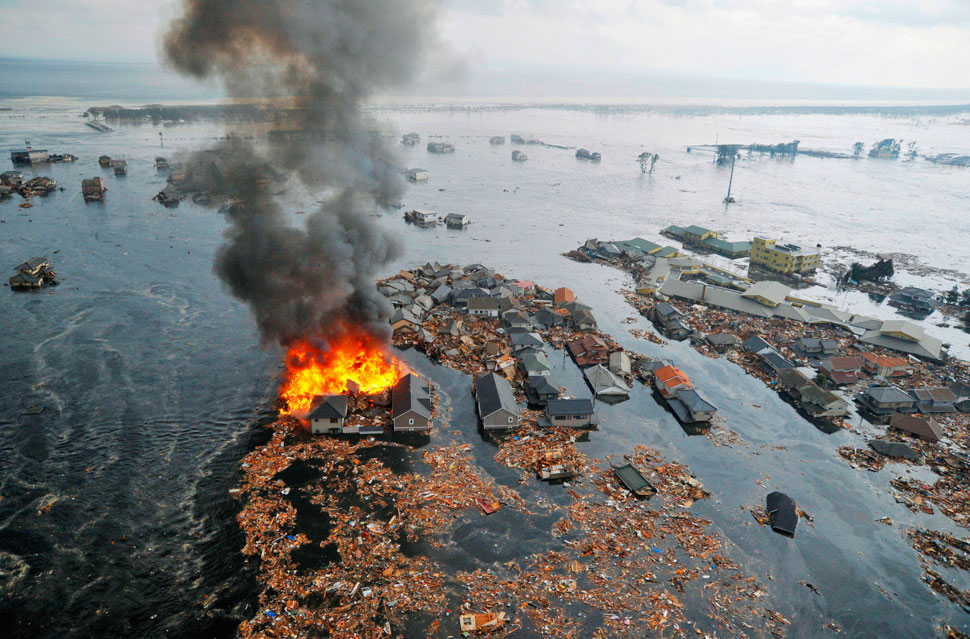
As I write, it’s a new dawn in Japan. Millions waking up to count the cost of their biggest ever quake, and devastating tsunami that followed. Official figures say 1000 dead but it’s bound to be several times that, with trains and passenger boats missing. The waves swept in at 500mph, the speed of an aircraft, sweeping boats, homes, lorries, before it. I have never seen video like it before, and I don’t think it has ever been captured on video from the air. See my earlier post for two videos. The ring of fire is a fragile place, and north Japan especially so, with many plates joining in this area. One plate pushing under the other caused the huge wall of water. Here are some REUTERS images from earlier today:

Terrible indeed. Not to mention the nuclear question.

Yet at times like these I always think of the hundreds of ongoing disasters that don’t get attention because it isn’t news, the millions dying from war, disease, hunger, and how little those in power seem to care or act; plus the millions living in ignorance of health, diet, wellbeing. Nor do I welcome the kind of talk that says natural disasters are humankind getting its comeuppance from God or the earth itself. It’s always easier to give things a reason or put a story behind it, way less scary than contemplating just how fragile life is.

Update: by the end of March, 28,000 people dead or missing.

An altogether quieter day here. Steps stepped: 5288

Oil spill link suspected as 10x normal amount of dead dolphins wash ashore

They may have disappeared the oil but they can’t disappear the effects


The discovery of more than 80 dead dolphins in the Gulf of Mexico is raising fresh concerns about the effect on sea life from last year’s massive BP oil spill.

The dead dolphins began appearing in mid-January along the coasts of Louisiana, Mississippi and Alabama in the United States. Although none of the carcasses appeared to show outward signs of oil contamination, all were being examined as possible casualties of the petrochemicals that fouled the sea water and sea bed after BP’s Deepwater Horizon drilling platform exploded last April, killing 11 men and rupturing a wellhead on the sea floor. The resulting “gusher” produced the largest marine oil spill in the history of the petroleum industry, releasing nearly five billion barrels of crude oil before it was capped in July.

The remains of 77 animals – nearly all bottlenose dolphins – have been discovered on islands, in marshes and on beaches along 200 miles of coastline. This figure is more than 10 times the number normally found washed up around this time of year, which is calving season for some 2,000 to 5,000 dolphins in the region. Another seven dead animals were reported yesterday, although the finds have not yet been confirmed by the US National Oceanic and Atmospheric Administration (NOAA).

One of the more disturbing aspects of the deaths is that nearly half – 36 animals so far – have been newborn or stillborn dolphin calves. In January 2009 and 2010, there were no reports of stranded calves, and because this is the first calving season since the BP disaster, scientists are concerned that the spill may be a cause.

via Oil spill link suspected as dead dolphins wash ashore – Nature, Environment – The Independent.

It’s sad bad news about the oceans

Black areas show the least biologically productive parts of the world’s oceans. These so-called ocean deserts are expanding much faster than previously predicted. The UNEP warns that by 2050 productivity will have decreased in nearly all areas and with it fish catches. It also says that the continuing decline in marine biodiversity will compromise the resilience of marine and coastal ecosystems to the impacts of climate change, as well as their ability to mitigate its effects.

Plastic waste on the Azores Islands in Portugal. The UNEP says marine litter poses a ‘dire, vast and growing threat’ to the marine and coastal environment. Most marine litter consists of material that degrades slowly, if at all, so a continuous input of large quantities of these items results in a gradual build-up

Nine other issues and pictures:

Marine ecosystems at risk from pollution

110217

I’ve been resting in bed again most of the day. Still feeling weak. I seem to get this every few months. I don’t go down as hard as I used to with dizziness and aches, but that same sick feeling I’ve felt for a few years now gets close by and I loose strength to do very much. There’s nothing for it but to rest up and sleep when I need.

I watched a move called Easy A. An above-average teen movie, interestingly for me set in Ojai, California where several of my friends live. The central character is quite bright yet falls into the trap of what people think of her, and is sucked under for a while by the rumour mill. You get to see quite a few shots of the city centre and surrounds, and of course a lot of the school. I really liked the parents; very funny yet caring.

Caroline passed her driving test. Good on her! The nerves failed her somewhat and she made some mistakes, but the examiner must have noticed her general competence and ability. That means no more driving practice sessions, which are quite hard on my own nerves. For the time being she’ll be able to borrow my car for work and after a while get her own.

This evening watched Human Planet about the grasslands of the world. Incredible footage of hunters stealing from lions, ambushing kudu, fishing for snakes, working with a bird to collect honey, fending off and then burning thousands of birds, catching and milking horses, and rounding cattle with helicopters. Men in copters was a strange site after 45 mins of traditional ways. Here’s a clip I uploaded of the kudu hunt:

Steps stepped: Not many more than 1000. Snoozes snoozed: Many.

27 Jan 2011

Today I turned 40. It feels like quite a milestone, and at the same time nothing special at all. I feel pretty much like when I was in my early 20s. My body is stronger and definitely healthier. I would say I am less fearful and more grounded. These are the things that count for me. So now I am middle aged! That’s pretty cool. I can relax a bit, be more eccentric, and more myself. A couple of changes I’d like to make: to walk every day, to relax about ‘how I should be’, to accept things as they are, and some of the struggling of youth can retire gracefully. No wars. I surrender. I reckon I’m a third of the way in – I’m going to be around until 110 or 120 years old. Why not? 40 years… a long time, and yet over in a week or two.

All the birthday wishes and facebook birthday messages is really fun and heart warming – thank you to my diverse and widespread friends.

300 years of fossil fuels in a 300 seconds animation:

Steps stepped 3780