Mindfulness In Plain English – Henepola Gunaratana – “You are a mess”

Extracts from Chapter One:

Buddhism as a whole is quite different from the theological religions with which Westerners are most familiar. It is a direct entrance to a spiritual or divine realm without addressing deities or other ‘agents’. Its flavor is intensely clinical, much more akin to what we would call psychology than to what we would usually call religion. It is an ever-ongoing investigation of reality, a microscopic examination of the very process of perception. Its intention is to pick apart the screen of lies and delusions through which we normally view the world, and thus to reveal the face of ultimate reality. Vipassana meditation is an ancient and elegant technique for doing just that.

Meditation is not easy. It takes time and it takes energy. It also takes grit, determination and discipline. It requires a host of personal qualities which we normally regard as unpleasant and which we like to avoid whenever possible. We can sum it all up in the American word ‘gumption’. Meditation takes ‘gumption’. It is certainly a great deal easier just to kick back and watch television. So why bother? Why waste all that time and energy when you could be out enjoying yourself? Why bother? Simple. Because you are human. And just because of the simple fact that you are human, you find yourself heir to an inherent unsatisfactoriness in life which simply will not go away. You can suppress it from your awareness for a time. You can distract yourself for hours on end, but it always comes back–usually when you least expect it.

You suddenly realize that you are spending your whole life just barely getting by. You keep up a good front. You manage to make ends meed somehow and look OK from the outside. But those periods of desperation, those times when you feel everything caving in on you, you keep those to yourself. You are a mess. And you know it. But you hide it beautifully. you hide it beautifully. Meanwhile, way down under all that you just know there has got be some other way to live, some better way to look at the world, some way to touch life more fully. You click into it by chance now and then. You get a good job. You fall in love. You win the game. and for a while, things are different. Life takes on a richness and clarity that makes all the bad times and humdrum fade away. The whole texture of your experience changes and you say to yourself, “OK, now I’ve made it; now I will be happy”. But then that fades, too, like smoke in the wind. You are left with just a memory. That and a vague awareness that something is wrong.

Go to a party. Listen to the laughter, that brittle-tongued voice that says fun on the surface and fear underneath. Feel the tension, feel the pressure. Nobody really relaxes. They are faking it.

At first glance this seems exceedingly morbid and pessimistic. It even seems untrue. After all, there are plenty of times when we are happy. Aren’t there? No, there are not. It just seems that way. Take any moment when you feel really fulfilled and examine it closely. Down under the joy, you will find that subtle, all-pervasive undercurrent of tension, that no matter how great the moment is, it is going to end. No matter how much you just gained, you are either going to lose some of it or spend the rest of your days guarding what you have got and scheming how to get more. And in the end, you are going to die. In the end, you lose everything. It is all transitory.

You can’t make radical changes in the pattern of your life until you begin to see yourself exactly as you are now. As soon as you do that, changes flow naturally. You don’t have to force or struggle or obey rules dictated to you by some authority. You just change. It is automatic. But arriving at the initial insight is quite a task. You’ve got to see who you are and how you are, without illusion, judgement or resistance of any kind. You’ve got to see your own place in society and your function as a social being. You’ve got to see your duties and obligations to your fellow human beings, and above all, your responsibility to yourself as an individual living with other individuals. And you’ve got to see all of that clearly and as a unit, a single gestalt of interrelationship. It sounds complex, but it often occurs in a single instant.

The purpose of meditation is personal transformation. The you that goes in one side of the meditation experience is not the same you that comes out the other side. It changes your character by a process of sensitization, by making you deeply aware of your own thoughts, word, and deeds. Your arrogance evaporated and your antagonism dries up. Your mind becomes still and calm. And your life smoothes out. Thus meditation properly performed prepares you to meet the ups and down of existence. It reduces your tension, your fear, and your worry. Restlessness recedes and passion moderates. Things begin to fall into place and your life becomes a glide instead of a struggle. All of this happens through understanding.

There is only one way you will ever know if meditation is worth the effort. Learn to do it right, and do it. See for yourself.
Teach Us To Sit Still – Constant Motion

More from the book Teach Us To Sit Still by Tim Parks (A Sceptic’s Search For Health And Healing). Parks has begun to experiment with sitting still and sees that he is always moving:

The pain surged to the fore. It was strong. You deal with the pain by keeping in constant motion, I realised now.  That was the truth. Even when I was still, I moved. My knee jerking. Scratching. My fist clenching and clenching. That kept the pain at bay. And when my body was still my mind moved. My mind was in constant motion. All day every day. The thoughts jerked back and forward like the knee that twitched. The difficulty when I was writing was not to come up with thoughts, but to give them direction and economy. Like a climbing plant that must be pruned and tamed, pruned and tamed. Above all pruned.


You are supposed not to be thinking.


Or not supposed to be thinking.


Or supposed to be not thinking.


I moved the ‘not’. Language is always on the move.


Even when I slept I moved. To sleep I needed to be on one side with one knee pushed forward. Then I switched to the other side. And I switched my earplugs from one ear to the other. I can’t bear having an earplug pressing the pillow. I pulled the earplug out, turned over, put the plug-in. Six times a night.

In the silence, eyes closed, I remembered a documentary had seen years before about some kind of desert lizard  that stopped its feet from burning on the hot Sahara sand by constantly and rapidly lifting and dropping the right front foot and back left foot, then the left front and back right. Alternately. They lifted and fell in the blink of an eyelid, almost too quick for the camera to see. A sort of Purgatory, I had thought, when I saw the images.


Teach Us To Sit Still – ‘Something’s got to change! Please!’

Next month I am going to a vipassana centre in Hereford for ten days of silence and sitting; meditation. Having  been on shorter retreats I’d like to immerse deeper into this exploration, and a ten-day retreat has been recommended by several friends. The decision to go was helped along by the book Teach Us To Sit Still by Tim Parks (the subtitle: A Sceptic’s Search For Health And Healing), a very interesting account of the author’s freedom from pain after suffering for many years. Having exhausted all other possibilities to treat this pelvic pain, he undertakes a sitting meditation practice, eventually learning that the pain itself is a gateway for release. The writing is refreshing as Parks had no interest in spiritual matters or meditation beforehand and so the language is refreshingly free of anything new age.

Getting desperate, Parks visits an Ayurvedic doctor while on business in India. He is told that his symptoms can be relived but…

‘On the other hand…’ He sat back and looked me in the eyes. His face was frank. ‘This is a problem you will never get over, Mr Parks, until you confront the profound contradiction in your character.’

I can’t recall being more surprised by a single remark in all my life.

‘Ah,’ I said at last.

‘There is a tussle in your mind.’

I sat still. I had wanted a different story, to challenge the ‘official medical version’. I was getting it.

‘What actually causes all this pain?’ I asked.

‘It is blocked vata.’

‘That is an energy that flows in the body,’ his wife explained. ‘ One of the five elements. It balances others and needs to be balanced by them. When the balance goes wrong, then the vata is blocked and causes pain.’

‘It is this mental tussle that blocks the vata,’ the doctor said.

I reflected. ‘So, what is the tussle about?’

‘Good question!’ The doctor smiled.

‘A tussle like this is not really about anything,’ his wife explained. ‘It is part of the prakruti.’

They began to explain what prakruti was: the amalgamation of inherited and acquired traits coming together to form the personality. If those traits were at odds and the two couldn’t mix, you’d be in trouble.

‘In that case a person may get the impression that his life is a series of dilemmas. He may think: if only I could resolve this or that dilemma, I will have resolved my problems. But each dilemma is only a manifestation of the deeper conflict.’

…’are you telling me it’s entirely psychosomatic?’

A slow smile spread across the doctor’s face. ‘That’s not a word we have much use for, Mr Parks.’

I looked at him.

‘You only say ‘psychosomatic’ if you think that body and mind are ever separate.’

The generator fell silent. What a pleasure sudden silence is, as when a harsh light goes out and your eyes can attune to the friendly dark. I picked up faint noises of plumbing, cries from the street, and I reflected that most people feel ashamed if told their problem is psychosomatic. They feel accused, guilty. It’s acceptable to have a sick body, that’s not your fault, but not a sick mind. The mind is you, the body is only yours. Choosing to go to an analysist because you’re unhappy is another matter. There is a respectability about being unhappy in a complicated way and most people would agree that to recognise you need professional help shows humility and good sense. But someone who makes his body ill because he doesn’t want to acknowledge his mind is in trouble, because he’s repressing his fears and desires and conflicts, is just a loser.

At exactly the moment I formulated this view, I realised that I was actually extremely eager for my problems to be psychosomatic. I was more than willing to countenance the idea that my pains only existed in my head, or that trouble in my head had brought them into existence in my body. I want to change, I told myself, returning from the bathroom. Why else would I have gone to an ayurvedic doctor? I want everything to change, inside me.

My parents tried to exorcise my brother and heal his polio. He was not changed. My sister gave birth to a severely handicapped daughter. The power of prayer did not transform her. Nor a trip to Lourdes. My father’s cancer was not helped by the laying on of hands. He lost his mind and died in pain. Afraid of anything that reminded us of their spiritual aberration, my brother and I counted entirely, perhaps aggressively, on official learning and official medicine; perhaps the only opinion we now had in common with my mother and sister was that all alternative therapies were baloney. Even today, if you mention acupuncture to my atheist brother, he will declare it  hocus-pocus. Just like my mother.

So where was I to turn, now that I had washed my hands of the doctors and they have me? The previous week, at the University, I had had to interrupt a lesson; for the first time the pain had obtruded  on my teaching. On Sunday afternoon at the stadium – for I was still an avid football goer – I was barely able to sit down during the second half of the game. I had to keep jumping to my feet as if excited by what was going on on the pitch. ‘Arbito di merda!’  I yelled, when nothing much was happening. My stadium friends laughed, but somebody client asked me to sit down.

On the bench in Regents Park, among the pleasant trees and lawns, I shouted: ‘Something’s got to change! Please!’ And a young man turned and glanced at me and hurried on.

120617: The incredibly still mind; Friends’ books; Secrets of Our Living Planet; Absent Fathers Day

This morning in meditation the mind so incredibly still. It’s there from nowhere, suddenly, if suddenly is without time. Previously, deep fluid breathing during morning stretches, continuing into the first part of the meditation.

Then it was back to the office after a week away for the school camp in Devon. Wading through emails, selecting the urgent ones to reply to first. After a while, remembered the Dragon Dictate system I set up before I left, so continued without typing. It’s still an odd experience, speaking to a computer instead of ‘operating’ it with the keyboard. I read yesterday that the new version of OSX, Mountain Lion, will have voice dictation built in. Mid morning we had a staff meeting, with all the foundation team in attendance, discussing the staff changes taking place this year.

The high winds of yesterday subsided leaving a fair and warm day. After lunch I was sat outside in the sun talking with a friend about the correct response, and some of the other responses, to the crisis in the world, ecologically, politically, religiously, seemingly every way. We talked at length about the perhaps-failed environmental movement. We concluded that we don’t know in the slightest what is really going on here, having explored various avenues over the last twenty years. Can this ‘not knowing’ lead to a new action? And how does true communication take place? It’s clear that this century will see huge changes, if not revolution. Saw another friend’s site online this afternoon discussing the overuse of the word ‘revolution’ where in fact it is hardly ever taking place. Both friends are in the process of writing books – The Birth of a River and The Order of Thought.

The Birth of a River:

This is the story of two unlikely companions travelling from Brittany to Britain in search of a mystical river. Armoran, a child of seven, has a special gift, he can communicate with nature like no other. Pursued and vulnerable, he turns to an old lighthouse keeper to help him carry out his mission.

In a world turned increasingly disconnected and destructive, this allegory sets the stage for a contemporary rural renaissance.

Birth of a River is a transforming novel about the wisdom of innocence, learning to listen to nature, and self-discovery.

The Order of Thought:

Why is it that des­pite all the out­ward tech­no­lo­gical advances of our civil­isa­tion, over the mil­len­nia we human beings have remained essen­tially bru­tal and cal­lous, liv­ing in con­fu­sion, sorrow and fear?

Why is it that the vari­ous “solu­tions” to our press­ing global prob­lems — offered often by the “best of minds” — only seem to make mat­ters worse?

Is it really inev­it­able that our future should just be more of the same — more exploit­a­tion, more war, more destruc­tion, more suf­fer­ing, more ideo­lo­gical con­flicts, more dis­agree­ments, more con­fu­sion, more mis­un­der­stand­ings and power-struggles?

Is there really no way of over­com­ing the divi­sions between sci­ence and reli­gion, the intel­lect and the emo­tions, the indi­vidual and the com­munity, one human being and another, the world we inhabit and us?

Or, could it be that the single root of all our troubles we can find right where we are? Could it be that the source of our general inco­her­ence lies within ourselves? Is it pos­sible for our con­scious­ness to change rad­ic­ally — not in some ideal­istic “New Age” sense, nor based on accu­mu­lated know­ledge and prescribed dog­matic pat­terns from the past? Could we make room for cre­ativ­ity and intel­li­gence? Could every one of us really make a difference?

Springwatch may be over (until Summerwatch then Autumnwatch) but this evening on BBC2 Chris Packham’s new series began: Secrets of Our Living Planet. ‘Science is the art of understanding truth and beauty.’ These days all I really want to watch on TV are nature programmes. The world of humans doesn’t interest me so much, at least not in TV form. Such impressive photography and new sights in episode one alone! Here’s some great footage of a variety of hummingbirds:

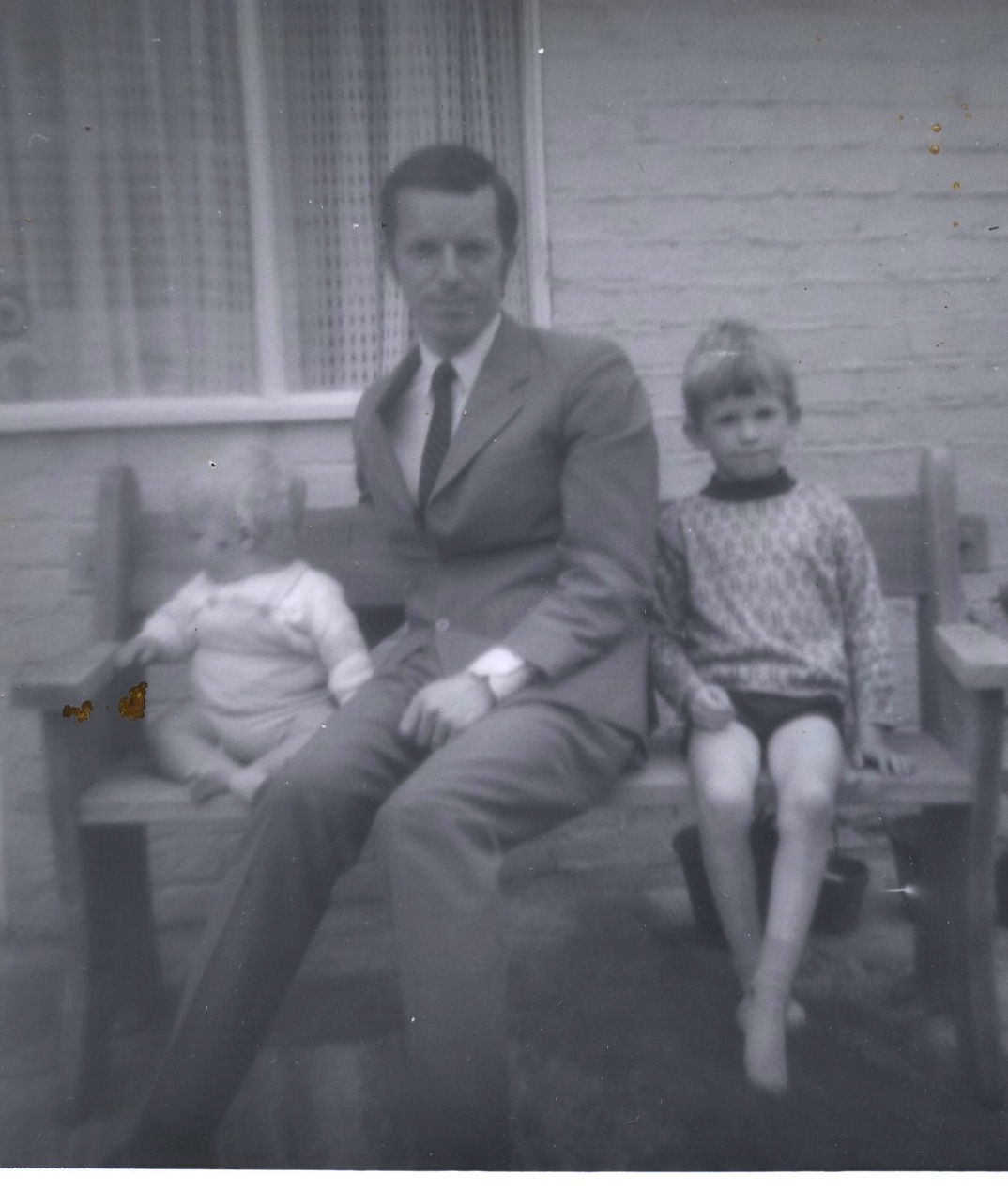
Today is Fathers Day in many countries. My father is no longer alive so today is a day to remember him. I wish he’d found his way, his correct response to the world. Here’s a picture of him with one of my brothers and I:

Happy Fathers Day!

A space used for one purpose with sacred intent

Half an hour from Brockwood near Chithurst is a monastery. A Buddhist monastery of a forest tradition. I don’t know the name of the tradition or founder. This evening a few friends and I went to their Saturday public service, with chanting, silence then a dharma talk. I’ve been a few times but not for a few years now. They have a (local) traditionally built meditation hall with oak beams, a stone floor and a big white Buddha. The moment I sat down in the hall my head felt different. Lighter, easier. Tingles spread from the temples, across the sides, top and back of the head and across the forehead. It remained for the two-hour session, the drive home, and is here now. I noticed, sitting in the hall more energy for awareness, attention, the same thought patterns more ready understood and with less power behind them. Tightness slipped away and there was a clean listening. Stepping out of time, falling out of time allows for a reset of accumulation. We all felt something in that hall; not imagined. The talk was given by a monk of twenty years who had just returned from eight months in the woods.

One friend was telling us about the time he was staying at the monastery and a group of physical special need pupils visited. (Sorry I don’t know if that is the PC term). Apparently one of their teachers was interested in Buddhism and had asked the Abbot for permission for them to visit. They entered the grounds, usual various behaviour of their bodies, shaking, rocking, dribbling, hitting, moaning (and good stuff besides, no doubt). They came to the meditation hall and at the routine time, the monks started their chanting. Very soon a girl who had been smacking herself in the side of the head stopped the smacking. Rockers stopped rocking. The children became very still. The teachers could hardly believe what had happened. Afterwards they said they had never known or heard of anything like it.

Some spaces have a very powerful affect, particularly those used for one purpose and with sacred intention.

First week of meditation

For the last week, since the retreat in Kent, I’ve been sitting quietly for 20 minutes twice a day. The first session after yoga asana in the mornings and then again early evening, after work on a week day. The effects have been quite strong already. A twice daily exploration of consciousness, with a natural shedding of the irrelevant or unnecessary, without choice of what is relevant and necessary. Many times, from nowhere, an overwhelming bliss. Many times, an incredible build up of energy, either in the head, heart or around the base of the spine. Through the day I seem to have greater capacity for thinking and more clarity in general, with an underlying calmness as I go about my usual activities. It’s not always easy, the rough rides with thought, efforts, desire, feeling every tension, every restriction and tightness. Without feeling these, it’s unlikely they will be understood or released. Just before, I do a few rounds of alternate nostril breathing, a simple, balancing pranayama.

Meditation/stress/ageing

So how could focusing on your thoughts have such impressive physical effects? The assumption that meditation simply induces a state of relaxation is “dead wrong”, says Raison. Brain-imaging studies suggest that it triggers active processes within the brain, and can cause physical changes to the structure of regions involved in learning, memory, emotion regulation and cognitive processing.

The question of how the immaterial mind affects the material body remains a thorny philosophical problem, but on a practical level, “our understanding of the brain-body dialogue has made jaw-dropping advances in the last decade or two,” says Raison. One of the most dramatic links between the mind and health is the physiological pathways that have evolved to respond to stress, and these can explain much about how meditation works.

When the brain detects a threat in our environment, it sends signals to spur the body into action. One example is the “fight or flight” response of the nervous system. When you sense danger, your heart beats faster, you breathe more rapidly, and your pupils dilate. Digestion slows, and fat and glucose are released into the bloodstream to fuel your next move. Another stress response pathway triggers a branch of the immune system known as the inflammatory response.

These responses might help us to run from a mammoth or fight off infection, but they also damage body tissues. In the past, the trade-off for short bursts of stress would have been worthwhile. But in the modern world, these ancient pathways are continually triggered by long-term threats for which they aren’t any use, such as debt, work pressures or low social status. “Psychological stress activates these pathways in exactly the same way that infection does,” says Raison.

via How Meditation Might Ward Off the Effects of Ageing — Science of the Spirit — Sott.net.

110220 Two Artists: Fred Thomaselli and Alan Watts

Digging the work of Fred Thomaselli. It reminds me of the lights inside the head in the eyes shut darkness. He cuts and pastes onto huge canvases then uses surfboard resins to cover it and seals with a blowtorch.

Each time when closing my eyes today, slipping below thought into an energetic space where something very different to the usual thinking, thinking, thinking takes place, in a space unrecognisable yet more familiar than ever. Other times, relaxing into the four-day headache and the sickness close by, revealing of forgotten memories, dreams, stuckness and tightness.

Listening today to Alan Watts, self-described ‘entertainer’ of awakening. Here’s a clip from YouTube (where there is a lot of Watts’ talks but mostly split up into small chunks), talking about looking without chatter, conceptions; magic in everyday life:

Steps stepped: hardly any

110209

Was I the only one last night who had a hip hop session on the iPod in the middle of the night, followed by listening to a Pema Chödrön talk? I suspect so. The beginning of a series of talks on shenpa (how we get hooked):

Somebody says a mean word to you and then something in you tightens — that’s the shenpa. Then it starts to spiral into low self-esteem, or blaming them, or anger at them, denigrating yourself. And maybe if you have strong addictions, you just go right for your addiction to cover over the bad feeling that arose when that person said that mean word to you. This is a mean word that gets you, hooks you. Another mean word may not affect you but we’re talking about where it touches that sore place — that’s a shenpa. Someone criticizes you — they criticize your work, they criticize your appearance, they criticize your child — and, shenpa: almost co-arising.

At one point last night she talked about going to the place no one wants to go to. This is exactly my path over the last decade and more. The hardest journey but maybe the only worthwhile one. And I am open to the possibility that there is no journey, and no place to go, but while time and space bound, is there anything else to do but address the issue? Of course, there is another, more common, more exhausting option: run and keep running.

A short taster:

My cheap pedometer collapsed today and refused to count. I stomped around watching the display and the counter wouldn’t budge. A new, better one, is on it’s way.

4 Jan 2011

Last night I began packing for the Lake District staff week. So far: ice skates. Then lay down and listened to music until sleepy, again lots of energy coursing through my body. It doesn’t make me jump and twitch and shake like it used to; the channels are clearer. Following a beat, a refrain, a melody took me on many journeys. Just stay with it and music can be magical, not just a distraction or entertainment.

Yoga this morning, a review day of the eight postures learnt so far in the course. The first four days of sustained practice are very familiar to me – the loosening up of the body, unwinding tensions, increased energy, greater awareness. It’s now that things get interesting and less predictable as these trends continue. While sitting I searched for the sick feeling of the last few days but only sensed traces of it. Often as thoughts ceased there was an immense presence of now, a pervasive energy tangible yet non-personal.

Back at work my lower back feels much stronger and I am sitting straighter. I feel it loosening up, too. I firmly believe yoga is the best prevention for back troubles. After all, most back pain is initially caused by weak back muscles. Look after your back – stretch. Gently.

WordPress are promoting postaday2011 (or postaweek2011). Today’s theme is: Share something that makes you smile. This works for me every time (although I do feel a little sorry for him, poor little blighter):

Perhaps even better, the remix:

Right, on with the packing, and laundry. Hoping for more anti-zap.

3 Jan 2011

Why are you unhappy?
Because 99.9 per cent
Of everything you think,
And of everything you do,
Is for yourself —
And there isn’t one.

~ Wei Wu Wei

Again some mighty weirdness during the night. Does anyone really understand what happens to consciousness during the night?

I definitely need to sleep longer during the winter; the 0730 alarm felt like 0530 and that’s after going to bed around 2200. After a wash and brushing teeth I continued with the 28 day yoga course. The addition of supine twists and standing hip rolls brought the emphasis to the waist and lumbar spine.

Sitting afterwards it is clear that awareness doesn’t need ‘doing’, and any direction, choice or purpose in the awareness prevents natural occurrences unfolding and expressing. The prevention of this is what I have been trying to do all this time and limits existence, but seems safer that way. In sitting quietly, the subtleties of this controlling become apparent and can be understood.

Some snow in the air this morning and a few flakes falling as I walked to lunch. The school is still very quiet, with less than ten people eating pizza at the kitchen the table, quite cosy. The scrap metal man gave us a pack of beers as a thank you. I guess he doesn’t know Brockwood very well. Or maybe he does. Some more snow in tiny flakes this afternoon, like dandruff from hair clouds.

Before work in the afternoon, reading an article in the New York Times, as the Bank of America braces itself for possible postings on Wikileaks. They haven’t been mentioned by name, but when Assange said he has evidence to ‘bring down a bank or two’ it is suspected Bank of America is involved:

That Mr. Assange might shift his attention to a private company — especially one as politically unpopular as Bank of America or any of its rivals, which have been stained by taxpayer-financed bailouts and the revelation of improper foreclosure practices — raises a new kind of corporate threat, combining elements of law, technology, public policy, politics and public relations.

“This is a significant moment, and Bank of America has to get out in front of it,” said Richard S. Levick, a veteran crisis communications expert. “Corporate America needs to look at what happens here, and how Bank of America handles it.”

I am working on the transcripts of Krishnamurti and David Bohm in 1975, a series of twelve conversations they had together. Bohm does well to draw out precise meaning from K, while the two of them explore deeply the questions of what is truth, actuality, the limits of thought and the nature of desire. Bohm has the tendency to describe while K tends to unfold and both of them together sustain a serious inquiry into the most important subjects. I am on the last transcript now; here’s some extracts:

David Bohm: Desire includes belief and hope. That is, belief amounts to accepting something as correct because you desire it to be so – because otherwise you have no proof, you see – and hope is just simply the belief that what you desire is going to be realised. So all three are one and the same. I think belief is in some ways more deceptive than plain desire.

DB: Self-deception: I believe that I am the same as something greater because I feel better.

DB: The point is that we can’t go on with desire [leading our actions]. I mean, if we do our society will be destroyed.

DB: Thought tends to think that consciousness is a manifestation of a being or an entity who is deeper.

K: Yes.

DB: Who is not only thinking, but thinking correctly, more or less, and who is also seeing, who is perceiving, his thinking is describing his perception, and who is also experiencing, you see. I think that’s important. That gives a sense of reality that this being is the experiencer who is experiencing the sensations.

K: Quite.

DB: And all that makes the thing very real, a reality independent of thought. If all that were not present then the sensations would not be regarded as all that important by thought. Thought is now trying to produce a better set of sensations in order to make you feel better, you see, the state of…

K: Yes – better sensation, more sensation.

DB: More and better. It doesn’t want worse, you see. (Laughs)

K: (Laughs) Yes.

DB: Now, you see, that’s an inherently crazy activity, because the only point or function of the sensations is to give you some factual information. And if thought tries to make them better it can no longer give you any information, you see. And the whole thing anyway is self-contradictory because that very attempt cannot be kept under control, and so on.

K: So we come back to the point: the content of one’s consciousness is the product of desire.

DB: Well, in general.

K: Yes, apart from the knowledge, functional knowledge, the rest of it is the movement and the accumulation of sensations and desires.

DB: Yes, it’s some sort of imprints which contain the records of all that and the instructions to produce them again.

K: Yes, yes – again. Memory.

DB: Yes. It gets stronger and stronger.

K: Yes. Now, can that movement of desire come to an end? Should it come to an end?

DB: Well, it seems from what we have said that it should.

K: But I mean, all the religions though they say this, yet they become monks in order to identify – you follow?

DB: But I think that’s the self deceptive nature of desire. You see, one thing that happens when the brain begins to see the destructive nature of desire, it begins to think, ‘I would rather not have desire.’

K: Yes.

DB: But it begins to desire a state of non-desire, you see.

K: Yes, that’s right, that’s right, that’s right. Desires a state of non-desire.

DB: And therefore the whole thing is silly, you see.

K: Of course.

DB: And desire has this self-deceptive nature – I can desire not to be conscious that I have desire, you see, and therefore that will vanish from my consciousness and I will have no desires. (Laughs)

K: So our question is: can desire, which brings illusion, self-deception, and all the complications of objective, changing desires – can the root of the desire be dissipated? I think it is only then that you see what is truth.

DB: Well, I mean, that is very clear to me. As long as there is desire nothing can be done.

K: Nothing can be done – absolutely. You see, sir, but it’s very difficult because most people think desire is necessary to live.

DB: Yes, I know that. That’s part of our tradition.

K: Now, is it possible to eliminate altogether desire?

Unfolding the laundry from the tumble drier, it was mega-charged with static. A little fluffy pad that somehow got in the laundry leapt from C’s hand to the clothes. I then tried to video it as a magic trick but it didn’t turn out like that. We discovered ‘anti-zap’!

A stability not of the mind

If you really listen – not merely verbally but profoundly – then you will see that there is stability which is not of the mind, which is the freedom from the past. Yet, the past can never be put aside. There is a watching of the past as it goes by, but not occupation with the past. So the mind is free to observe and not to choose. Where there is choice in this movement of the river of memory, there is occupation; and the moment the mind is occupied, it is caught in the past. And when the mind is occupied with the past, it is incapable of seeing something real, true, new, original, uncontaminated.

– Krishnamurti

Close by

Stay close by
There’s nowhere to go
Stay close to feel
There’s nothing to do
In attention

Then thoughts think
Stay close by

Do we need a belief of any kind, and if we do, why is it necessary? That’s one of the problems involved. We don’t need a belief that there is sunshine, the mountains, the rivers. We don’t need a belief that we quarrel. We don’t have to have a belief that life is a terrible misery with its anguish, conflict, and constant ambition; it is a fact. But we demand a belief when we want to escape from a fact into an unreality.

– Krishnamurti

Gentleness allows

I began the morning not with asana but with yoga nidra and then awareness meditation. The true value of gentleness. Gentleness – not you being gentle so much as gentleness itself. Why be hard on yourself or on others? Hardness restricts, gentleness allows.

Book of Life, 3 Feb:

If I am stupid and I say I must become intelligent, the effort to become intelligent is only a greater form of stupidity; because what is important is to understand stupidity. However much I may try to become intelligent, my stupidity will remain. I may acquire the superficial polish of learning, I may be able to quote books, repeat passages from great authors, but basically I shall still be stupid. But if I see and understand stupidity as it expresses itself in my daily life … then that very awareness brings about a breaking up of stupidity.

To sit quietly (124/365)


To sit quietly (124/365), originally uploaded by :Duncan.

Once a day. Twice a day is harder. And yet it’s becoming the most treasured part of the day. To do nothing. To sit. To see what’s happening. To see what you are up to now. To see what’s what. Things happen in that quiet. The brain can relax a little. The body too. Moment after a moment, nothing much. A mild surprise: what, I don’t have to do anything? What, nothing to plan for, go over, worry about? And then next moment there is planning, then there is worrying. And yet then there is just you again. Still sitting there.

Three Days of Dynamic Meditation

Three days of dynamic meditation, three nights of intense dreams.

First night’s dream, eating whatever I wanted. A big plate of full English in front of me and a strong feeling of ‘do I have to?’ I really didn’t want to eat that meat.

The second night was full of drunken dreams, staggering about, lost and confused, unable to think clearly or act.

The third night, smoking. Dry mouth and smelly. Singe marks on a rug that wasn’t mine and throwing stubs out the window, grubby on the clean driveway.

These are not the usual random dreams; something is changing. It is definitely stirring things up, the breathing, releasing, jumping, being still and then dancing. I look forward to the pureness of it, the direct feeling during that hour after work. The nausea is lessening each day and I’m able to immerse more fully. Less wondering how long left of each section.

An ancient pond. A frog jumps in. Plop! (86/365)

From the excellent book on meditation: The Everyday Meditator. I started doing the Dynamic Meditation from it today. It made me queasy and it’s a long time since I felt nausea. Is it the worse feeling? One of them. It was also hard work: 10 minutes of breathing deeply, moving the body. 10 minutes of catharsis, letting out whatever you feel. 10 minutes of jumping up and down, hoo-ing. 15 minutes stopped dead still. 15 minutes dancing. It’s a stirring meditation, based on the idea that if ‘modern man’ attempts to sit quietly, he just can’t do it, so bound up are we in our issues and thought patterns. This ‘meditation’ supposedly gets things moving, allowing release of deep stored emotions and habits. We’ll see. More on this later.

Instead of the Pub – 1996

I am alone in the house, Saturday night. My choice – turned down all offers. Something is keeping me from doing these things and for the first time it isn’t shyness or nerves. I don’t want to talk, or listen to, bollocks in a pub, or drink, or smoke. That kinda excludes me from the society I know.

Following my mind closely these days and when I stop and lie down, after about five minutes, things start to change. Tingles and tightness, pleasant, at the back of my head. And moments, sometimes lasting, of bliss. Thought stops it. Ceasing thought can’t be forced. This feeling seems the most important thing in my life right now.

Element Beginners Yoga

My latest home class has been courtesy of the Element Beginners Yoga DVD, led by Elena Brower. I normally resist these ‘keep moving at all times’ dynamic style classes because I’ve found it hard to keep connected to the breath and body while switching from pose to pose to pose. This one is different. Yes, it raises energy but in a careful manner, and enough small pauses and quietening poses to balance it out.

The instructor is like some kind of Italian goddess, looking tall, strong, elegant. I love the way she reminds me to smile often throughout the 50 minutes routine. I’m not sure of the style of yoga, what it’s called or the lineage, nor do I care, as long as it feels good. I’ve been really loving the ‘return to the land of the living’

Thought

So you are thinking, or,  there is thought, doing its ahead and behind thing, going over the past, planning ahead. Then you realise this and there’s a resistance, as if thought is bad somehow. The tendency then is to stay in that slightly guilty feeling for a while, thought having been stepped upon by the ‘no, you shouldn’t be thinking.’ So the ‘shouldn’t be thinking’ feeling is the master for a while, but thought will come back somehow. That’s the tendency.

How about continuing to think despite the feeling that you shouldn’t be thinking? Then you get a much more interesting situation, a game, a play between the two thoughts, more equal. The original thought cannot exactly do what it would do without the ‘shouldn’t be thinking’, and the ‘shouldn’t be thinking’ doesn’t get it’s victorious (if slightly guilty and violent) residential.

Then something new can happen because the thought won’t ‘come up’ as it’s already up and the no won’t ‘no’ because it’s already ‘no-ing’, and the game will naturally cease after a time, allowing a fresh energy and understanding, awareness.

Thought does not ‘come up’. More like ‘drives in’, but the concept of feeling of it ‘entering something’ needs to be questioned. Just because it’s a common experience doesn’t make it true.